The moment comes for all entrepreneurs at one point or another after they hire someone to manage their accounts and then realize that the first decision they have to make is what accounting method should be applied. At first glance, this issue may appear as an exclusively technical question and something that should be left up to experts; however, the choice of method will influence every single report concerning your company.
Luckily for everyone who faces such a dilemma, the decision itself is not a hard one once the principles behind each accounting method are clear. The difficult part is the realization that the chosen method is no longer applicable and it is time to change it.
What Cash Accounting Means
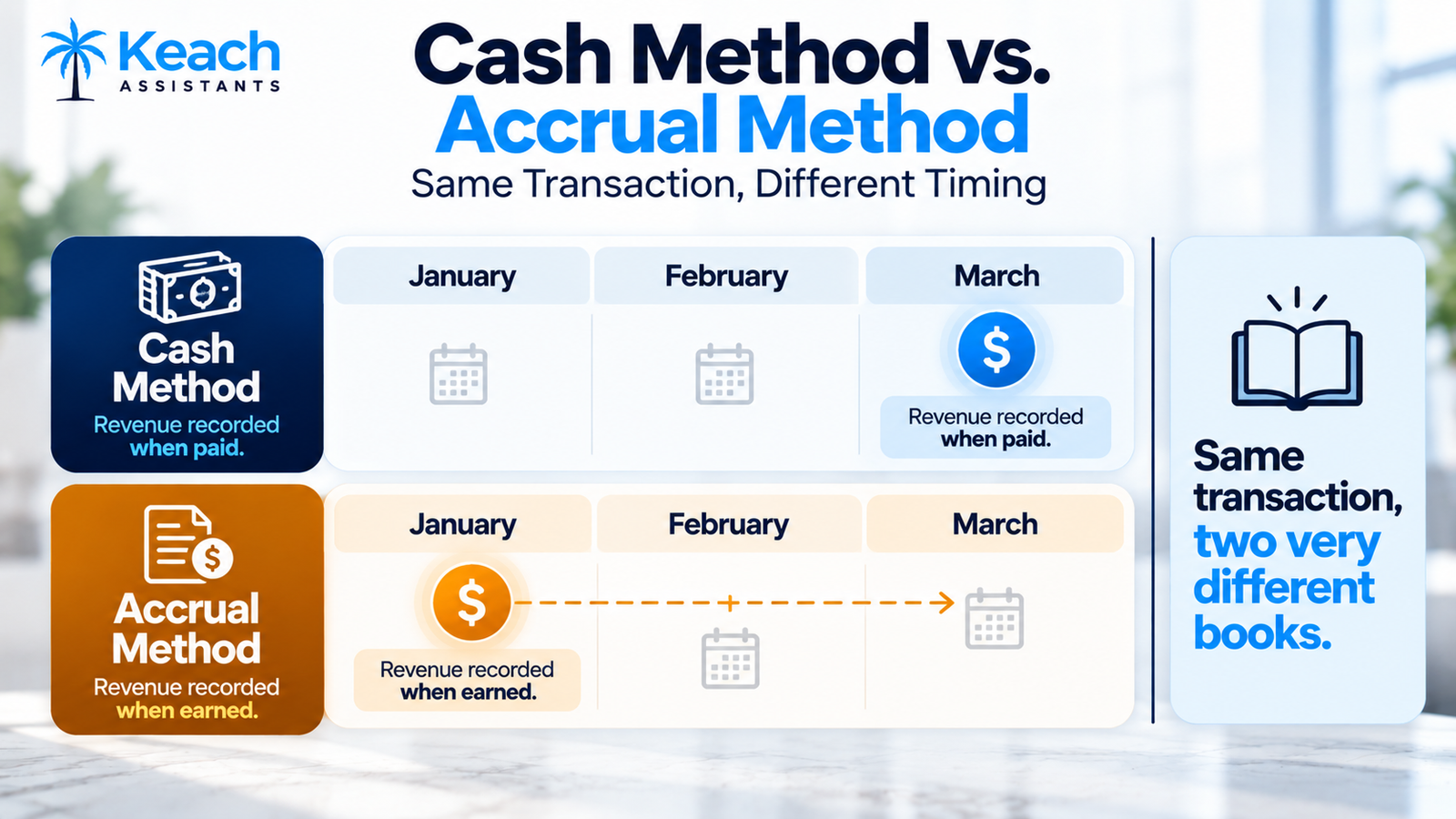
Cash accounting is one of the easier options, and, as you might guess, it functions just as its name would suggest. Revenue is recognized when funds are received into your account, and expenses are recognized when funds leave your account. So if your client pays his or her bill in March for services provided in January, then the revenue will be recognized in March. Likewise, if you pay your vendor in April for services that were performed in February, then the expense will be recognized in April.
Cash accounting is appropriate for smaller companies since it is more consistent with the way the business owner thinks about money. Your checking account balance and book balance match, making it easy to understand your cash flow. For the smallest businesses and for sole proprietorships, cash accounting is generally the more obvious option due to the lack of required bookkeeping work.
The downside is that cash accounting hides things a growing business needs to see. A strong month with a lot of outstanding invoices looks weak on the books, and a slow month where several payments happened to land looks strong. Neither picture reflects what’s happening in the business, and that gap widens as the business grows.
Not Sure Which Method Your Books Should Use?
Keach Virtual Assistant works with both and explains the trade-offs clearly.
What Accrual Accounting Shows Instead
In accrual accounting, revenues are recorded when they are earned and expenses when they are incurred, irrespective of when the cash transaction takes place. The billing for work done in January becomes part of January revenue, despite the customer paying for it only in March. The invoice for services provided in February will be recorded in February, despite it being settled in April.
The result is that this system gives a better view of how the business is doing during a certain period, which is why large companies and public companies are required to use this system. This is the reason why lenders, investors, and buyers also prefer the accrual method, since it is economically accurate as compared to the cash method.
However, accrual accounting becomes complicated because it involves recording accounts receivable, accounts payable, and deferred revenues, among other things. When deciding on which method of accounting to use for outsourced bookkeeping services, one needs to look at how much the extra effort is worth and, in most cases, as the business grows, having inventory and receivables makes it worthwhile.
Cash vs Accrual Accounting: Same Sale, Different Timing
How the Choice Affects Your Reports
The accounting method you choose changes what your profit and loss statement tells you, which is why understanding how to read a profit and loss report explained makes more sense once you know which method produced it. A cash-based P&L reflects what happened in the bank account during a period. An accrual-based P&L reflects what happened in the business during the same period, and those two reports can look very different even when the underlying activity was identical.
Cash reports tend to be easier to read for owners who are new to financial statements, because every number traces back to a transaction that moved money. Accrual reports require a bit more interpretation, but they show trends that cash reports hide, including whether revenue is growing, whether margins are holding, and whether the business is profitable rather than just collecting payments on time.
This is exactly the kind of thing a bookkeeping VA services provider deals with regularly, since the method you’re on affects every monthly report they produce and every question you’re likely to ask about the numbers. For most small businesses, cash accounting is fine during the early stages, and the switch to accrual happens when the business reaches a point where the cash-based picture stops being useful.
That threshold varies by industry and business model, but e-commerce sellers tend to hit it faster than service businesses because inventory, deferred revenue, and marketplace payouts all complicate the cash timeline in ways that make accrual reporting more valuable.
When an E-Commerce Store Should Switch
There’s a specific moment for e-commerce businesses when cash accounting starts to cause problems, and it usually shows up as a mismatch between what the store appears to be earning and what’s sitting in the bank.
This is exemplified in the case of marketplace sales. Amazon and other marketplaces hold the money deposited to them for weeks before making deposits to your account. Therefore, a profitable month of sales may not be reflected accurately in a cash-basis P&L statement because of the delayed payment. There is also the same issue with inventory purchases where you purchase the inventory months before selling it, and this is not considered in the cash basis of accounting.
That is why the issue of when a growing e-commerce store should move from cash to accrual basis of accounting is so common. Once the inventory, deferred revenue, and marketplace payouts are a big part of the business, then cash accounting will no longer give you useful information. Moving to the accrual basis in such cases will enable you to see the margins, seasons, and profitability of your business accurately.
Freelancers face a similar problem but on a smaller scale. The lack of employees, inventory, accounts receivable, and the simplicity of the books is why freelancers really need a virtual bookkeeper until the administration starts to take up valuable billable hours of the freelancer.
How Remote Bookkeepers Handle Both Methods
Bookkeepers who work remotely manage both accounting methods regularly, which means the choice doesn’t limit who you can hire. What changes is the workflow and the tools involved.
Under cash accounting, the bookkeeper reconciles transactions directly from bank and credit card statements, which keeps the process straightforward. Under accrual accounting, the workflow expands to include tracking invoices sent and received, monitoring payment terms, and recording revenue and expenses at the point they’re earned rather than when cash moves.
That extra work is why accrual bookkeeping usually takes longer per month, and why how remote bookkeepers handle cash vs. accrual accounting methods often becomes a deciding factor in which approach a business ends up choosing.
Working with a bookkeeping VA services provider that handles both methods means you can switch without changing teams, which matters because switching accounting methods mid-relationship is easier when your bookkeeper already understands both systems.
Making the Decision Practical
A few guidelines tend to hold true across business types, and they’re worth keeping in mind when the decision comes up.
- Cash accounting works well for sole proprietors and service businesses with simple transactions.
- Accrual accounting makes more sense once inventory, receivables, or deferred revenue become significant.
- Lenders and investors usually want to see accrual-based financials.
- Switching methods requires adjusting prior reports, so the change is worth planning rather than doing mid-quarter.
- Tax implications vary by structure and jurisdiction, so it’s worth confirming with a tax professional.
Ultimately, it should be made purposefully as opposed to just defaulting to cash accounting. Businesses default to cash accounting because that is what was done during their early stages of operation, and there has been no re-evaluation even when there is an urgent need to change the accounting method.
It is especially critical in growing businesses, as the problem tends to become a bigger question of timing that plays into the consideration of when to hire a remote bookkeeper as opposed to continuing to operate with in-house options.
There is also the practical side of things as well, as far as the problems with cash flow go. If there are issues with invoices coming out on time, late reminders, and late payments, the accounting method is not going to solve the problem. It is one of the reasons why so many businesses have shifted to bookkeeping VA services to handle invoices and late payments directly.
Conclusion: A Decision Worth Making Deliberately
Cash versus accrual isn’t a choice between right and wrong. It’s a choice between two pictures of your business, and the one that serves you better depends on what you’re trying to see. Keach Virtual Assistant works with businesses using both methods and can help you decide when a switch makes sense rather than leaving the decision to habit. Whether you’re a freelancer running simple books or an e-commerce brand watching inventory and receivables complicate the picture, the goal stays the same. Financial clarity that matches how your business operates.
Ready for Books That Reflect the Real Picture?
Keach Virtual Assistant handles both methods and helps you choose.
FAQs
Which accounting method should a small business choose?
A cash basis is typically preferred for a small business that has simple transactions. Accrual becomes increasingly relevant if inventory, accounts receivable, or deferred revenues become a part of business operations, since it reflects what is going on in the business.
Can I change the method in the future?
I can, but I have to adjust previous financial statements to make sure all the reports are consistent. This should be done at the beginning of a fiscal year.
Does accounting technique affect my taxes?
It might do. Depending on the type of business structure, varying accounting techniques lead to differences in revenue and expense recognition.
What is the preferred approach for investors and creditors?
The most preferable approach is the accrual approach because it accounts for the business’s economic condition rather than the flow of payments. This is why it is used by bigger organizations and is mandatory in publicly held businesses.
Is my bookkeeper able to use either approach?
Yes. A professional bookkeeper uses both systems; however, the accrual system takes longer per month because of its nature.