There is a particular type of fatigue experienced by small business owners which tends to occur at certain times of the year when the receipts are mounting up, the bank statements aren’t quite tallying with your recollection of income, and you tell yourself that you will get to it during the weekend only to find there isn’t time then either.
This works for a while because the numbers are easy enough for you to remember, but then they aren’t, and the gap between your perception of the financial standing of your business and the reality begins to grow in quiet, insidious ways, affecting every one of your decisions regarding pricing, staffing, and expansion. Knowing when to hire a remote bookkeeper for small business doesn’t hinge on some magical figure in terms of revenue; it’s usually much more subtle than that.
Why Owners Delay This Decision Longer Than They Should
Almost nobody regrets hiring bookkeeping help too early, and plenty regret waiting. That asymmetry is worth sitting with for a second, because the reasons people delay are usually the same reasons they should act.
Cost is the first objection, and it’s a fair one when cash flow is tight and every recurring expense feels like a risk. Control is the second, since handing your financial records to someone outside the business can feel like losing visibility rather than gaining it. Then there’s a third reason that rarely gets said out loud, which is that bookkeeping feels like something a competent owner should be able to handle alone, so outsourcing it carries a faint sense of failure that has nothing to do with actual business sense.
What usually breaks the deadlock is a deadline. Tax season arrives, an accountant asks a question you can’t answer, or a lender requests financials you don’t have ready, and suddenly the cost of waiting becomes concrete instead of theoretical. By then you’re usually paying for the delay in both money and stress.
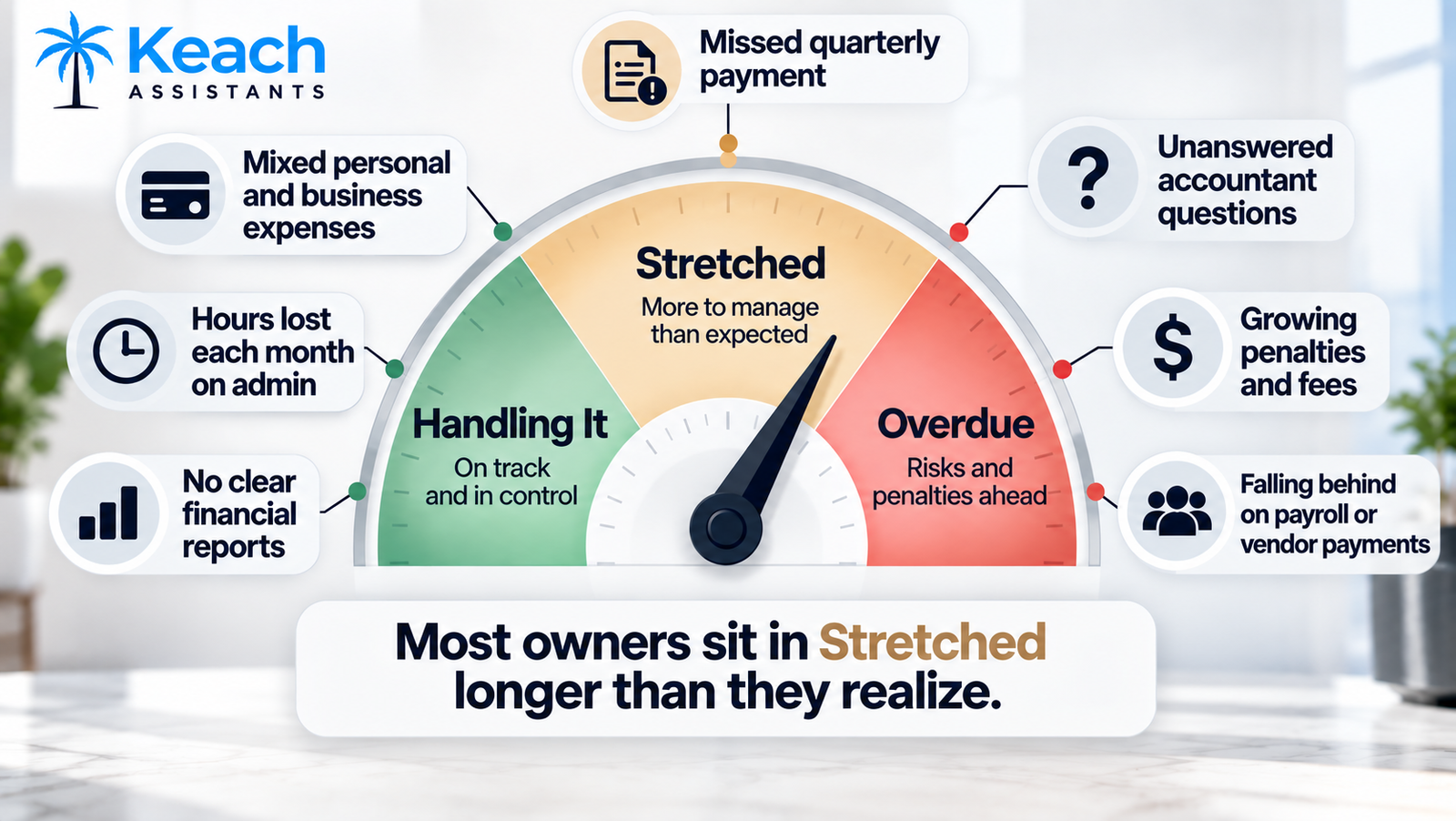
Stretched: The Hidden Business Burden
The Signals That Say It’s Time
A few patterns tend to show up before the decision becomes obvious, and they’re worth checking against your own situation rather than dismissing as normal busyness.
- You’re spending more than a few hours a month on books and still feel behind.
- You’ve missed, or nearly missed, a quarterly tax deadline.
- Receipts and invoices live in three places, and you’re not certain what’s been claimed.
- Business and personal spending overlap in the same account.
- You’re pricing products without knowing your real margins.
- Your accountant asks for records you can’t easily produce
Two or more of those, and the conversation shifts from whether to hire help into how quickly you can find it, because each one compounds the others over time. A missed quarterly payment becomes a penalty. Mixed expenses become a deduction you can’t claim. The problems don’t stay separate for long.
Tired of Reconstructing Your Books Every Quarter?
Keach Virtual Assistant keeps the records clean month to month.
Revenue Thresholds and What They Actually Mean
Searching for a specific revenue threshold to hire a remote bookkeeper for startups usually leads to disappointing answers, because the honest ones are all variations of “it depends.” A freelancer with a handful of retainer clients might have straightforward books at a much higher income than a retail business juggling inventory, payroll, and sales tax across multiple states.
Complexity drives the decision more than revenue does, and the practical rule is simple enough to remember. If your financial records take longer to maintain than they take to understand, you’ve crossed the line. That might happen at a modest income for a business with messy structure, or much later for a service business with one income stream and predictable expenses. Comparing yourself to a revenue benchmark someone posted online tells you almost nothing about your own situation.
Cost Versus Benefit, Without the Sales Pitch
The comparison worth making is rarely bookkeeping fees against nothing, because doing it yourself isn’t free. It costs hours you could bill, decisions you delay, and mistakes that surface later as penalties or missed deductions. Those costs are real even though they don’t show up on an invoice.
Weighing the cost vs. benefit of hiring a remote bookkeeper vs. in-house usually comes down to scale and preference. An in-house hire makes sense when volume is high enough to fill a full-time role plus payroll and benefits, while a remote bookkeeper fits the far more common situation where you need a few focused hours a month without the overhead of an employee. For most small businesses in the growth stage, remote wins on flexibility alone, and the transition is easier than bringing someone into an office.
Figuring Out What to Hand Over
The hardest part for many owners is drawing the line between what stays and what leaves. Learning how to know when to delegate a small business’s financial recordkeeping is mostly about separating judgment from maintenance, because the calls about pricing, investment, and strategy should stay with you while categorization, reconciliation, and record organization can go without much risk.
A useful test is asking whether the task requires context only you have. Deciding whether to raise prices does. Entering a receipt into the right expense category doesn’t. Most bookkeeping tasks fail that test, which is exactly why they’re worth handing off. The ones that pass are the ones you should protect, because they’re the reason you started the business in the first place.
Where This Gets More Complicated
Some financial lives involve more moving parts than a standard business, and those situations tend to need professional support sooner rather than later. Rental income is a good example, since depreciation, cost basis, and how property earnings interact with regular income take real expertise to handle correctly.
If you’re wondering whether freelancers need a virtual bookkeeper even without employees or inventory, the answer often comes down to how many income streams you’re managing and whether tax season turns into an annual scramble. Multiple clients, platform payouts, and quarterly obligations add up faster than most people expect, and the cleanup cost grows the longer it waits.
Conclusion: The Cost of Waiting
Most owners who bring in a remote bookkeeper say the same thing afterward, which is that they wish they’d done it a year earlier. The relief isn’t really about the money saved, though that matters too. It’s about knowing where you stand without digging through receipts to find out.
Keach Virtual Assistant works with small businesses that want their books current, their records organized, and their tax season uneventful. Whether you’re a freelancer with a growing client list or a business with employees and inventory, the goal stays the same, which is financial clarity you don’t have to reconstruct from scratch.
Ready to Know Your Numbers Without the Scramble?
Keach Virtual Assistant handles the records so you can read the reports.
FAQs
How many hours per month would a bookkeeper require?
It depends on how many transactions your business deals with, but generally, a few hours per month. Some businesses that have payroll and stock may require more. Providers usually change their working hours based on your requirements.
Is it possible for a bookkeeper to work alongside an accountant I currently work with?
Yes, it is possible and works quite smoothly. While your bookkeeper would make sure all your records are clean and organized, your accountant will take care of your tax return and overall financial planning.
Which software does a bookkeeper use?
Bookkeepers usually work in QuickBooks, Xero, and Wave, but can get used to any software you are using now. It’s good to ask before booking a bookkeeper’s services.
How will I be able to tell whether or not my business is too small for a bookkeeper?
If your transactions per month amount to just a few, and you are not stressed during tax periods, it may be that you don’t require professional assistance right now. The question changes once the administration starts taking up time that would otherwise be spent doing something else.
What will happen if I change my bookkeeper in the future?
Changing bookkeepers is normal practice and is quite simple. All of your information is stored in online software, so the next service provider can easily take over from the previous one.