Ask ten small business owners who handle their books, and you’ll get a mix of answers. Some will say their accountant. Some will say themselves. A few will admit they’re not totally sure, and they’ve been avoiding the topic because tax season is still months away. That last group is honestly the most honest one.
The confusion usually comes down to two roles that sound similar and get used interchangeably. A bookkeeper and a CPA. Both deal with money, both work with numbers, and both get mentioned in the same sentence when someone’s trying to figure out who to hire. But they do completely different jobs, and mixing them up is why so many businesses end up paying for the wrong service at the wrong time.
What A Bookkeeping VA Does
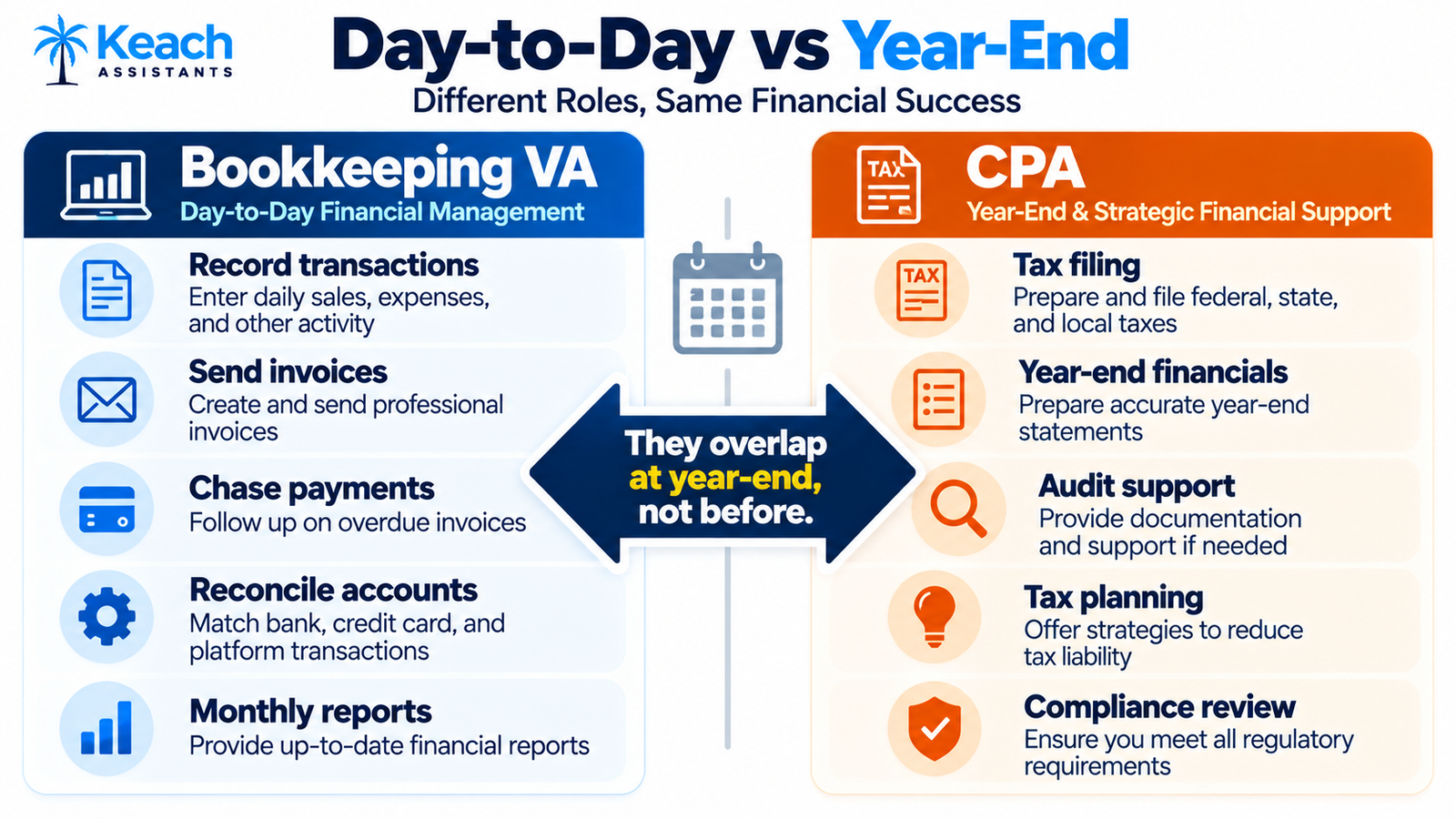
Your bookkeeping virtual assistant does the dirty work. Whatever transactions flow through your business are documented, classified, and reconciled. Your invoices are sent, payments are processed, your expenses are accounted for, and by the end of the month you have actual accounts that represent your activities.
It is a continuous process. It takes place every week, sometimes every day, and it does not stop until the next month. An effective bookkeeping VA constantly monitors your business processes throughout the year, rather than when the deadline is looming on the horizon. They will spot odd expense reports, find lost invoices, and notice the mysterious doubling of the payment made by a supplier without any reason.
They also do all the less pleasant tasks, which a lot of small business owners would prefer to avoid. It includes chasing the outstanding balances, dealing with unprocessed invoices, and reconciling the payments from Amazon, Etsy, and eBay, which are coming in large chunks and are impossible to decipher.
And here’s the thing about the difference between a bookkeeping virtual assistant and a certified public accountant. The bookkeeper is in the trenches. They see every transaction. They know which months are slow, which clients pay late, and which expense categories have been creeping up. That visibility is genuinely valuable, and it’s exactly what a CPA doesn’t have.
What A CPA Does
A CPA is a licensed professional who handles the higher-level financial work. Tax filing. Tax planning. Financial statement preparation. Audit support. Compliance issues. Advice on business structure and major financial decisions.
The important point here is the term periodic. Most accountants do not deal with transaction recording or accounts receivable chasing. They work with already processed numbers, meaning that they rely completely on the proper bookkeeping work that has been done beforehand. If there is a problem with the bookkeeping side of things, the accountant must fix it before being able to proceed, and it often takes more money than filing itself.
This is where a lot of business owners get stuck. They hire a CPA expecting the CPA to also manage the books, and then discover that’s not the arrangement. The CPA files the taxes. The bookkeeping is someone else’s problem. If nobody’s doing it, that problem becomes expensive fast.
Bookkeeping vs CPA Services: What’s the Difference?
Where the Confusion Comes From
The confusion makes sense if you think about how most people describe their financial help. “My accountant handles it.” That phrase could mean a bookkeeper, a CPA, or both. It’s vague enough that nobody questions it.
But the roles are genuinely distinct. A bookkeeper can’t file taxes or offer formal financial advice the way a CPA can. A CPA can’t realistically keep up with every transaction in a small business without charging bookkeeper rates for bookkeeping work, which would be overkill. Each role exists because it serves a different purpose.
This is why working with a bookkeeper VA services provider and a CPA at the same time isn’t redundant. It’s actually the standard setup for most well-run small businesses. The bookkeeper keeps the records clean month to month. The CPA uses those records once a year to file taxes and offer strategic guidance. Everyone does what they’re best at.
Not Sure Who Should Be Handling Your Books?
Keach Virtual Assistant covers the day-to-day, so year-end isn’t a scramble.
The Cost Comparison, Without the Sales Pitch
The cost comparison between a bookkeeping virtual assistant and a CPA firm usually comes down to hourly rates and how many hours you actually need. CPAs charge more per hour because their licensing, training, and expertise are more specialized. Bookkeepers charge less because the work is more routine.
But the raw hourly rate isn’t the real story. The real story is what happens when the books are messy. If a CPA has to spend ten hours reconstructing your year before they can file anything, you’re paying CPA rates for bookkeeping work. That’s the most expensive way to run your financials, and it’s the pattern most business owners fall into by accident.
Deciding between daily bookkeeping via VA versus annual accounting via CPA is not even a decision; you must have both, and the only question that remains is whether the daily tasks are being done in an efficient way so that the annual ones can concentrate on what they should be doing.
Who Benefits Most From a Bookkeeping VA
Not every business needs the same setup. Some need a bookkeeper and a CPA. Some can handle one of those roles themselves.
Freelancers with simple finances often wonder whether freelancers really need a virtual bookkeeper at all, and the honest answer is that it depends on volume. A few clients, a few expenses, straightforward taxes? A spreadsheet and a CPA might be enough. A dozen clients, mixed income streams, quarterly estimates? The math shifts quickly.
The same logic applies to niche businesses. Real estate agents, for example, have commission structures and expense categories that most generic bookkeepers don’t fully understand, which is why dedicated bookkeeping VA services for real estate agents– commissions and expenses exist in the first place. The work isn’t harder. It’s just specific, and specificity matters.
E-commerce sellers hit a similar wall. Learning how a bookkeeping virtual assistant matches Etsy, eBay, and Amazon payouts clarifies why most sellers eventually need help. Marketplaces batch payments, deduct fees, and hold funds on their own schedule, which makes reconciliation a nightmare without someone tracking it properly.
And then there’s the invoice side. Anyone who’s ever chased a late payment knows how much time it eats. That’s why so many business owners now lean on a bookkeeper VA service that can handle invoices and late payments directly. It’s not just about clean books. It’s about keeping cash flowing without the awkward conversations.
Conclusion: Two Roles, One System
The bookkeeper and the CPA aren’t competitors. They’re parts of the same system. One keeps the numbers accurate so the other can make decisions from them. Skip either piece and the whole thing gets more expensive and less reliable.
Keach Virtual Assistant provides the nuts and bolts of that process through bookkeeper VA services that make sure your numbers stay up-to-date, your invoices get paid, and your books stay organized enough for your CPA to do his or her work without any extra sorting. You’re a freelance writer, an e-commerce entrepreneur, or a business owner in a service industry; it doesn’t matter. Numbers that work for you.
Ready for Books That Hold Up All Year?
Keach Virtual Assistant keeps the day-to-day clean so year-end stays simple.
FAQs
Is my CPA able to take care of my bookkeeping also?
They can, but it will definitely cost you more than expected. Rates of CPAs are charged due to their certification and expertise, but bookkeeping does not require any of it. Premium prices for simple tasks are not really worth it.
How often should a bookkeeper update my books?
Weekly updates are preferable, although monthly updates are acceptable if you have low amounts of transactions. The frequency of updates helps prevent any surprises while going through your accounts.
Should I hire a bookkeeper even if my CPA is filing my taxes?
Certainly, if you want your taxes to be filed correctly and reasonably priced. A CPA can only make use of the accounts that are provided to them. If accounts require rebuilding, then you are actually paying CPA rates for bookkeeping.
What is the difference between a bookkeeper and accountant?
A bookkeeper is responsible for recording and organizing transactions. An accountant interprets figures, deals with tax planning, and gives financial advice. A bookkeeper updates the accounting records. An accountant uses them for planning and filing.
Is it possible that one person can perform both jobs efficiently?
Not very likely in the case of a small business. The two jobs require different skills and responsibilities, and most people who perform one job effectively are specialists in it but not in the other. It will be more effective and cost-effective to divide the tasks.