It seems like an inevitable step forward in business development to enter the world of international selling until one discovers that after the first month of international business operations, accounting becomes completely unclear. The order comes from Germany, payment through Stripe comes in Euros, the refund goes in pounds, the supplier’s invoice comes in dollars; everything falls into one bank account on different days under different exchange rates.
And that is when it becomes apparent that the accounting structure was created to operate with only one currency, which no longer fits the current business model. The interaction with a remote bookkeeper experienced in working with cross-border sellers provides insight into the whole process.
Why Multi-Currency Breaks Standard Bookkeeping
Standard bookkeeping assumes one currency and one set of numbers. Multi-currency breaks that assumption in several places at once, and each one introduces its own complications.
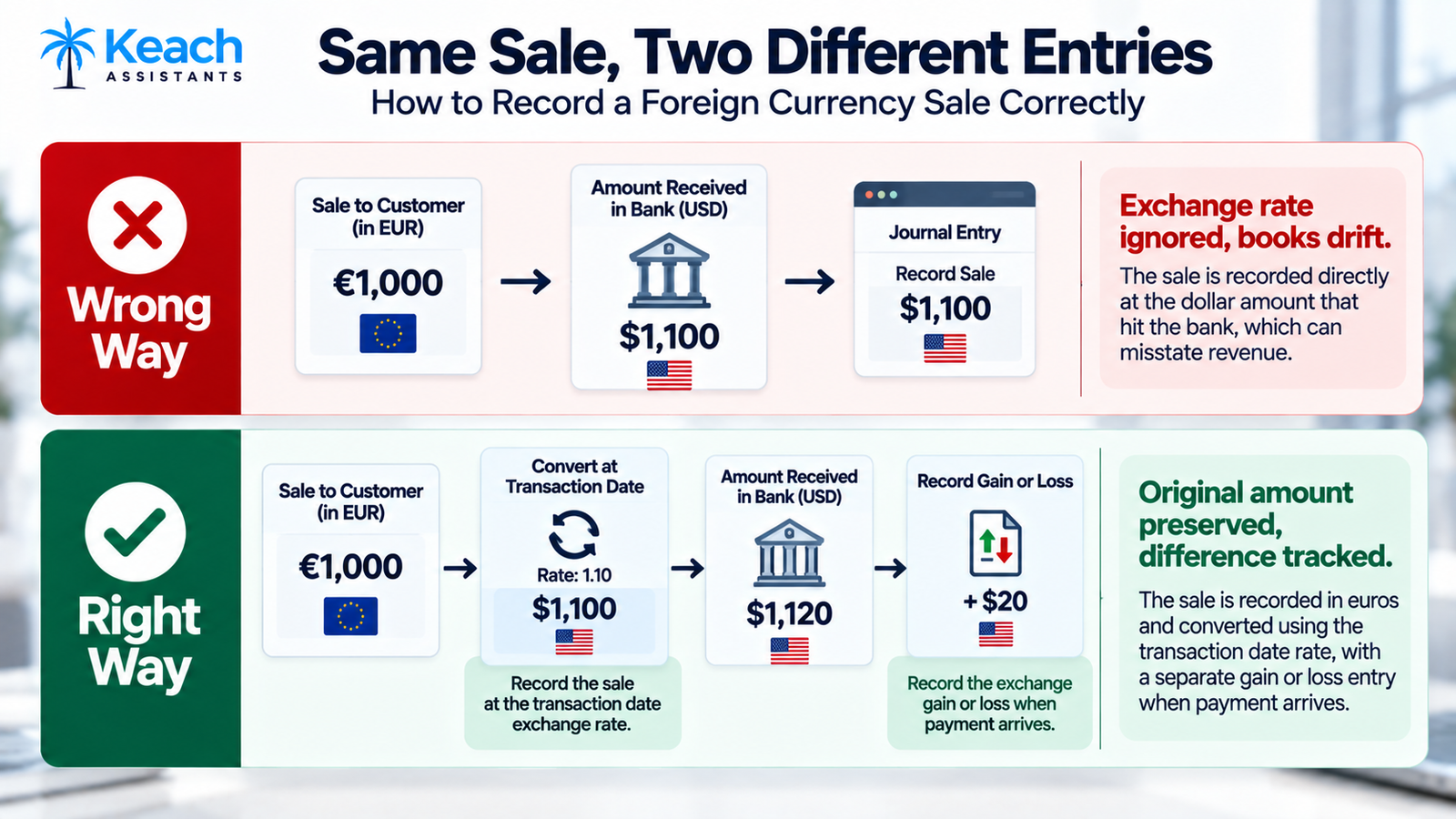
The first problem is timing. A sale recorded in euros on the day it happens won’t match the dollar amount that eventually lands in your bank account, because the exchange rate moved between those two moments. If the books use the bank deposit as the source of truth, revenue gets recorded at the wrong value, and the discrepancy stays invisible until someone reconciles months later.
The second problem is reporting. A profit and loss statement only makes sense in one currency, which means foreign transactions have to be translated before they can be summarized. The translation method matters, because different approaches produce different numbers, and the choice affects everything from tax liability to how the business looks to a lender.
International Sales Making Your Books Unreadable?
Keach Virtual Assistant keeps multi-currency records clean and accurate.
How Foreign Transactions Get Recorded
Understanding how to register foreign currency transactions in QuickBooks by remote bookkeepers will be initiated by the information that the program is already designed to do this if used properly. All currencies have their own accounts, and QuickBooks is able to track the original figure along with the converted one, which makes the process of tracking more efficient, as the two figures are not replaced by each other.
Thus, the process of recording the sales in the currency in which it was carried out involves applying the exchange rate of that day to the transaction and leaving all further exchange rate differences tracked by the system. This difference is the place where all gains and losses related to exchange rates are situated, and it becomes an additional problem of multi-currency accounting.
The management of exchange rate gains and losses in multi-currency e-commerce bookkeeping has nothing to do with forecasting the movements of exchange rates. The thing is that such gains and losses will appear separately in the P&L statement of the business, and for the large-volume sellers they may become quite important at certain moments.
Foreign Currency Accounting: Right Way to Record a Sale
Payment Gateways and the Reconciliation Problem
The introduction of multi-currency payment gateways, such as Stripe and PayPal, in QuickBooks introduces one more challenge, since they operate a little bit differently from regular banks and don’t make deposits the same way as the latter do. Instead, they batch transactions, hold balances in several currencies, make deductions for various fees, and settle transactions in their own way, so one transaction can consist of dozens of underlying sales.
That requires careful reconciliation, where all deposits should be matched to the underlying transactions, and fees charged deducted separately to avoid including them in the revenue stream. This practice is often ignored by sellers, resulting in an overstatement of the revenue in their accounts and making the tax reporting impossible, since actual margins are not visible there.
Also, Stripe and PayPal operate differently when it comes to currency conversion of deposits made by foreign customers. While some of the deposits are converted into the store’s currency and settled in it, other payments are left in the original currency until manual transfer takes place. It’s important to know which scheme is used in each case.
Cross-Border Tax and VAT Tracking
It may be challenging to work with sales taxes within one country. Now, when we add international tax compliance, things get even more complicated because there are various rules on the taxation process for every particular jurisdiction involved.
Handling international sales tax and VAT for remote e-commerce bookkeepers means that you need to keep separate categories of taxes for every jurisdiction; know the threshold levels at which you are required to register; ensure that your marketplace-collected tax is reported separately from the tax you collect on your own. Making mistakes here will not only make you have difficulties with keeping records but also lead to compliance issues that might arise several years after with penalties for it.
Here comes one of the situations when it really pays off to cooperate with a professional who is well-versed in the field. Sales tax laws change often and differ from country to country. As a result, people often reach a point where they understand that a simple spreadsheet cannot manage the complexity anymore. That’s the time when it becomes a question of when it is time to hire a remote bookkeeper.
When the Current Setup Stops Working
Most sellers don’t realize their bookkeeping has outgrown its original design until something breaks. A reconciliation stops matching. A tax filing reveals numbers that don’t reflect what the business actually earned. An accountant asks a question nobody can answer.
The symptoms usually revolve around internationalization due to the fact that it is the point where the number of foreign transactions, gateway transactions, and tax classes exceeds a certain limit, which manual accounting simply cannot cope with. Incorrectly reported revenues, exchange rates hidden in rounding, and costs hidden in deposits- these are all signs of one and the same problem.
And freelancers experience the smaller version of it, so it is important to know in advance whether freelancers require the services of a virtual bookkeeper, since the problem becomes similar at a smaller scale. The threshold level will be much lower than you think.
What Changes Once Someone Experienced Takes Over
The biggest difference isn’t the software or the reports. It’s that the books start telling the truth about what the business is actually doing.
Revenue gets recorded at the right value. Exchange rate gains and losses show up where they belong rather than disappearing into rounding errors. Gateway fees become visible line items instead of invisible deductions. Tax categories stay organized enough that filing season doesn’t turn into a forensic project. A remote bookkeeper who handles international sellers has seen every version of this mess before, which is why the cleanup usually moves faster than owners expect going in.
For e-commerce sellers specifically, that clarity changes decisions. Pricing becomes easier to set when you know your real margins. Supplier negotiations get simpler when you can see actual landed costs. And expansion into new markets becomes a calculated move instead of a gamble, because the books show exactly what the last market cost to run.
Conclusion: Numbers That Match the Business
Cross-border sales complicate the process with issues that accounting using a single currency was not meant to address, and doing so will only postpone the time when somebody will have to unravel it. Doing things correctly at the start simplifies all future processes, including taxation, raising funds, and profitability analysis.
Keach Virtual Assistant works with e-commerce sellers who run international sales and need books that reflect what’s really happening. Whether you’re dealing with Stripe payouts in three currencies or tracking VAT across five jurisdictions, the goal stays the same.
Clean records, accurate numbers, and financial clarity you can act on, whether that comes from a remote bookkeeper on the team or from finally having systems in place that don’t need to be rebuilt every time a new market opens up.
Ready for Books That Handle International Sales Properly?
Keach Virtual Assistant reconciles multi-currency transactions accurately.
FAQs
Why do my foreign sales not match with QuickBooks and my bank?
Due to changes in the exchange rate from the transaction date to the settlement date. In QuickBooks, both the amount and exchange rate change are tracked separately, whereas your bank only shows the converted amount.
Does QuickBooks support multiple currencies?
Yes, once you activate multi-currencies and assign accounts to each currency. It is important how it is set up rather than the software, since incorrect settings are what cause the errors at reconciliation time.
How are exchange rate gains/losses accounted for?
Exchange rate gains and losses are reflected as individual lines in the profit & loss statement. It is the difference in exchange rate between the transaction date and the actual settlement date of the payment.
Do I need a separate tax category per each country?
In most cases, yes. This is due to different regulations in different countries and thresholds that would make it necessary for registration.
What’s the biggest mistake sellers make with international bookkeeping?
Recording foreign sales at the converted amount that hits the bank, rather than in the original currency at the transaction date. It looks simpler, but it hides exchange rate activity and makes reconciliation nearly impossible later.