Amazon search is changing. For years, sellers optimized for keywords. They stuffed titles with phrases. They repeated terms in bullet points. The algorithm rewarded keyword density.
That approach is fading. Amazon introduced COSMO, a new AI system that understands intent. It also launched Rufus, a shopping assistant that answers customer questions. These tools do not just match keywords. They understand context, meaning, and user behavior.
Sellers who adapt will win. Sellers who cling to old tactics will struggle. Amazon virtual assistants are helping businesses make this transition. They understand how AI search works and how to optimize for it.
What COSMO and Rufus Actually Are
COSMO is Amazon’s new AI-powered search engine. It goes beyond keyword matching. It analyzes customer intent. It considers context like occasion, problem, and use case. It learns from billions of interactions to predict what shoppers actually want.
Rufus is Amazon’s shopping assistant. It appears in the app and answers customer questions. It pulls from product listings, reviews, and Q&A sections. It helps shoppers find products without typing exact keywords.
Together, these tools change how products get discovered. Understanding them is the first step toward ranking well.
Why Traditional Keyword Optimization Falls Short
Old-school optimization focused on keywords. Sellers identified high-volume terms. They placed those terms in titles and bullet points. They repeated keywords as often as possible.
COSMO and Rufus do not work that way. They understand synonyms and related concepts. They interpret questions. They recognize that a customer searching for “gift for new mom” wants specific product types, not just those exact words.
Listings optimized only for keywords miss these signals. They may rank for exact matches. They fail to appear for intent-based searches. The result is lost visibility and lost sales.
What Amazon Listing Optimization Means Now
Amazon listing optimization still matters. But the approach has shifted. Instead of stuffing keywords, sellers must write for understanding.
This means using natural language. It means answering questions customers actually ask. It means describing use cases and scenarios. It means including details that Rufus can pull when responding to queries.
An Amazon virtual assistant trained in AI optimization understands these nuances. They rewrite listings to match how COSMO and Rufus interpret products. They focus on clarity and context, not repetition.
Struggling to Rank in Amazon’s New AI Search?
Old tactics are not working. The algorithm has changed.
How To Optimize Amazon Listing For Rufus
Rufus pulls information from multiple sources. To appear in its answers, listings must contain relevant details.
Answer Common Questions
What do customers ask about your product? Include those answers in bullet points and descriptions.
Describe Use Cases
When would someone use this product? Mention scenarios like “perfect for travel” or “ideal for small kitchens.”
Include Specifications
Dimensions, materials, compatibility. Rufus uses these details when matching products to queries.
Write Natural Sentences
Readable descriptions perform better than keyword lists. Rufus understands language, not just terms.
Hire Amazon VA For COSMO Algorithm
The COSMO algorithm rewards relevance and intent. Hire an Amazon VA for COSMO algorithm support to ensure listings align with how it evaluates products.
A skilled VA analyzes search trends. They identify what customers actually want. They rewrite titles and bullet points to match intent. They optimize backend keywords for semantic relevance, not just volume.
This work takes time. It requires understanding both Amazon’s systems and customer behavior. A VA with experience in AI-driven search delivers results faster.
Amazon Rufus AI Listing Strategy
An effective Amazon Rufus AI listing strategy focuses on context. Here is what matters.
- Use conversational language in descriptions.
- Include synonyms and related terms naturally.
- Address multiple use cases in bullet points.
- Answer questions in Q&A sections proactively.
- Encourage reviews that mention specific scenarios.
These tactics help Rufus understand your product. They improve the odds of appearing in AI-generated answers.
Here is a visual breakdown of AI search optimization:
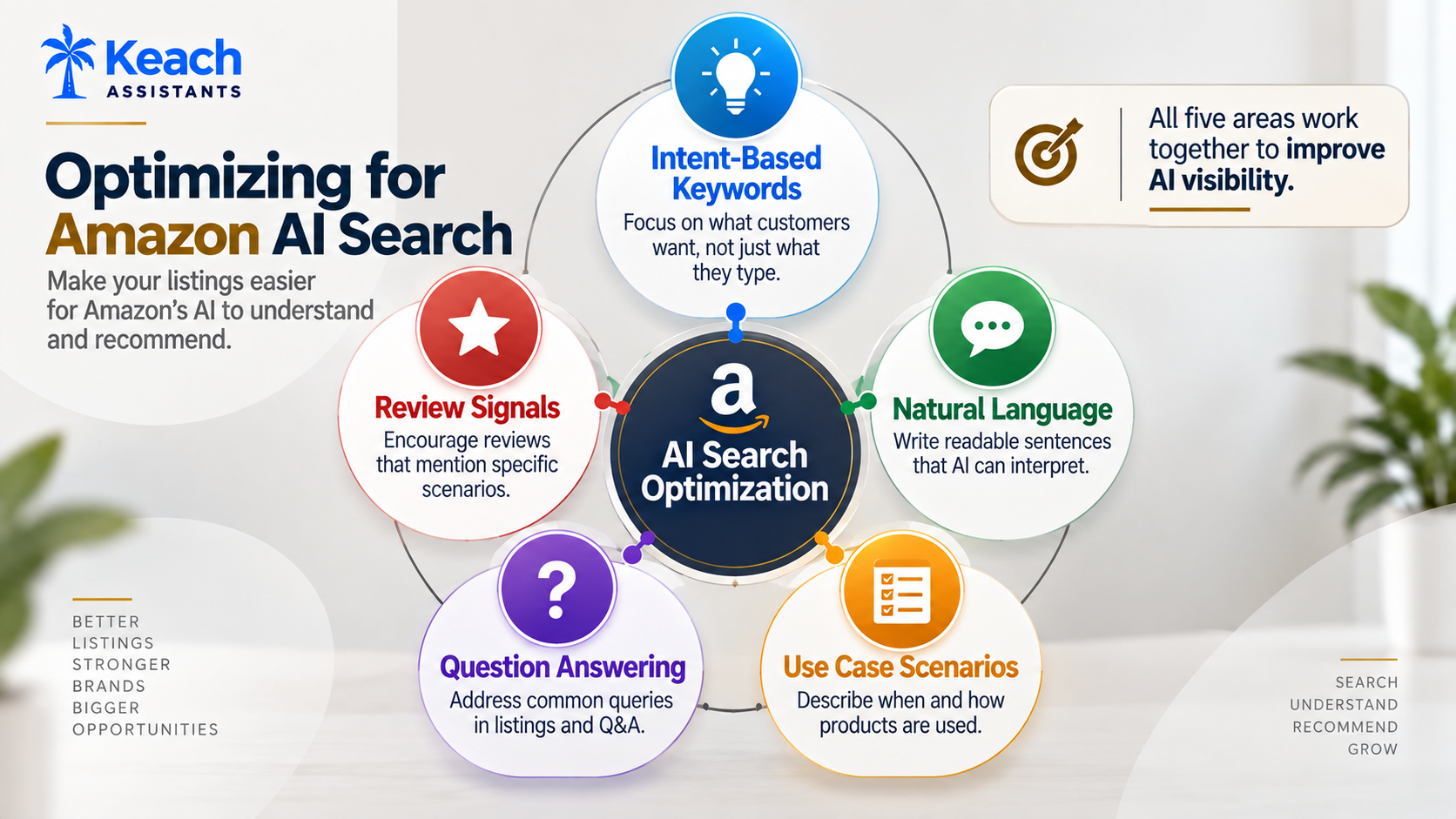
Amazon Semantic Search Optimization Services
Semantic search focuses on meaning, not exact matches. Amazon semantic search optimization services help listings appear for related queries.
A VA identifies semantic clusters. They find terms that relate to your product. They weave those terms into listings naturally. This expands visibility without keyword stuffing.
The Role Of Reviews And Q&A
COSMO and Rufus learn from customer behavior. Reviews and Q&A sections provide valuable data. Products with detailed reviews perform better in AI search.
VAs can manage review generation. They follow up with customers. They encourage detailed feedback. They also populate Q&A sections with helpful answers.
Measuring Success
Traditional metrics like keyword rankings still matter. But new metrics matter too. Track how often your products appear in Rufus answers. Monitor conversion rates from AI-driven searches. Success in AI search requires patience. The systems learn over time. Consistent optimization improves results.
Why Experience Matters
Not all VAs understand COSMO and Rufus. These are new systems. Many assistants still use outdated tactics. Look for VAs with proven experience in AI optimization. Ask about their approach. Review their results. The right partner makes the transition smooth.
Conclusion
Amazon search is evolving. COSMO and Rufus reward listings that understand intent. Traditional keyword stuffing no longer works. Amazon virtual assistants help sellers adapt. They optimize listings for AI search. They write for understanding. They track new metrics. Keach Virtual Assistant provides skilled VAs who understand these systems. The future of Amazon search is here. Get ahead of it.
Ready to Rank in Amazon’s AI Era?
COSMO and Rufus are here. The old playbook is outdated.
FAQs
What is COSMO on Amazon?
COSMO is Amazon’s AI-powered search system. It analyzes customer intent and context. It goes beyond keyword matching to predict what shoppers actually want.
What is Rufus on Amazon?
Rufus is Amazon’s shopping assistant. It answers customer questions in the app. It pulls from listings, reviews, and Q&A to help shoppers find products.
How do I optimize my listing for AI search?
Write natural language descriptions. Include use cases and specifications. Answer common questions. Use synonyms and related terms. Focus on intent, not just keywords.
Why is keyword stuffing no longer effective?
AI systems understand meaning, not just terms. They interpret context and intent. Listings stuffed with keywords miss these signals. They fail to appear for intent-based searches.
When should I hire a VA for Amazon AI optimization?
Hire a VA when you lack time or expertise to optimize for COSMO and Rufus. These systems are complex. Experienced VAs deliver results faster and more reliably.