Every agent who’s ever picked up the phone to cold call has asked the same question at some point. How many calls must be made in order to secure one appointment? The question seems easy enough to answer, but in truth, it all comes down to a few variables that may differ from one marketing campaign to another.
However, that kind of response won’t be too helpful if you’re sitting there looking at a list of two hundred numbers and wondering whether you should spend half an hour making fifty more calls. So here’s a more tangible answer. The real benchmarks in relation to the performance of cold calling in real estate and what influences them.
The Real Numbers Behind Cold Calling Conversion
Cold calling benchmarks vary wildly across sources, but the general range for real estate is somewhere between one appointment for every twenty to fifty conversations. That’s conversations, not dials. The difference matters enormously.
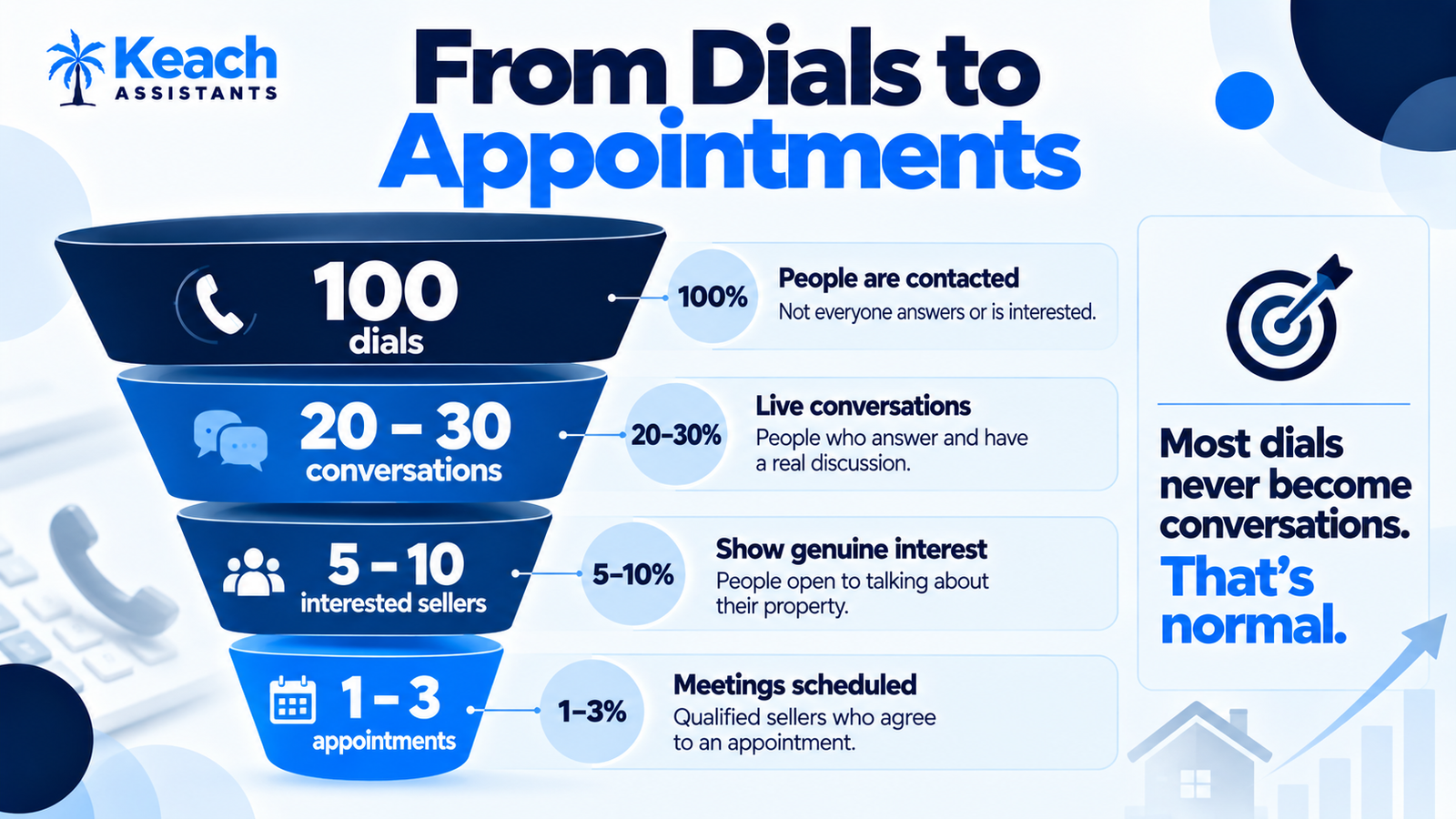
Most cold calls don’t turn into conversations. People don’t answer, or they hang up immediately, or they’re not the person on the listing. To be realistic, for every ten phone calls, only two or three will actually result in a conversation. This implies that making one single appointment would mean making about seventy to one hundred fifty phone calls.
For agents doing this themselves, that number can feel discouraging. It’s also why so many people quit cold calling before they’ve given it a fair chance. The first fifty dials rarely produce anything, and it’s easy to conclude the whole strategy doesn’t work when the data is still accumulating.
So how many cold calls to get one listing appointment is really about setting expectations correctly. If you know the ratio going in, the early dry spells don’t feel like failure. They feel like the cost of doing business.
Making Calls All Day and Getting Nowhere?
Keach Virtual Assistant runs cold calling campaigns with trained real estate callers.
What Changes the Ratio
The single biggest variable is list quality. A list of expired listings that just came off the market behaves completely differently than a scraped list of homeowners who’ve never considered selling. The first group has a reason to talk. The second group mostly doesn’t.
Script quality matters too, but not as much as people think. A mediocre script on a great list outperforms a great script on a bad list every time. That’s why experienced callers spend so much time on list selection before they ever pick up the phone.
Timing is the third factor. Calling a FSBO at 8 AM on a Tuesday reaches a different version of that person than calling at 6 PM on a Thursday. Small changes in when calls happen produce meaningfully different outcomes over hundreds of dials.
From Dials to Appointments: The Cold Calling Funnel
How Long Does It Take to Make 100 Cold Calls
How long does it take to make 100 cold calls? Real estate comes up because agents want to know how much of their day this actually consumes. The honest answer is somewhere between two and four hours for most people, assuming they’re not stopping to research each number.
That range shifts based on a few things. How fast the list is organized. Whether the agent is leaving voicemails. How long conversations actually run when someone picks up. And how disciplined the caller is about moving to the next number rather than dwelling on a bad interaction.
For agents hiring help, this matters because it defines the workload. A virtual assistant making cold calls for four hours a day can work through a full list in less than a week, which means the campaign produces appointments faster than an agent doing it themselves in spare moments.
It’s also worth tracking dials per hour, because that number reveals inefficiencies. A caller managing thirty dials an hour is moving well. Someone managing ten is probably getting stuck on things that don’t matter, like researching each number before calling.
What Conversion Rate Benchmarks Tell You
The cold calling conversion rate benchmarks real estate agents should track are the ones that measure outcomes, not activity. Inputs are calls and discussions. Outputs are appointments, viewings, and listings.
Generally, a good campaign will generate from two to five percent of its calls as appointments. This would translate to two to five appointments out of one hundred calls and matches the ratios provided before. If less than that takes place in terms of conversion, then the need arises to make certain changes in the process.
What the majority of agents do not track is the follow-up conversion ratio. Many appointments are not made on the very first call but rather on the third or fourth discussion when the seller thinks it over. This ratio should be tracked separately because many campaigns that seem to be underperforming when it comes to initial statistics perform well when follow-ups are taken into account.
Why Most Agents Can’t Hit the Numbers Alone
Here’s the uncomfortable truth about cold calling in real estate. The math adds up, but only with consistent volume. The agents who do twenty calls a day and then take a week off when it gets hectic won’t succeed since the funnel will never have momentum.
For the agents to be successful, they need to have consistent volume. Consistent volume for most agents is fifty to a hundred dials a day, five days a week. Not many agents can maintain such a volume of work and still list the property and handle the closing and all the other aspects of business. Something always has to give, and it is always the calling.
This is the point where the help becomes necessary rather than a luxury. When working with real estate cold calling services, the agent is able to maintain a consistent volume of work without having to do each call themselves.
Where Answering Services Fit Into the Picture
Cold calling isn’t the only way to capture leads, and it doesn’t work in isolation. Agents who invest in outreach are usually also investing in inbound, because the two feed each other. Every cold call that turns into an appointment also generates callbacks, referrals, and questions that have to be answered.
That’s why it’s worth understanding what real estate teams experience when they use VAs for cold calling in real estate, because the results usually include more than just booked appointments.
Looking at how much real estate cold calling services cost alongside what a real estate answering service typically charges gives a clearer picture of what a combined approach runs.
And when the volume justifies it, comparing options like an AI answering service vs. a live receptionist vs. a VA for real estate agents helps determine the right mix for a specific team’s needs.
When to Bring In a Cold Calling Partner
The decision to outsource cold calling usually comes down to time. If you have the time and the temperament to make a hundred calls a day, you probably don’t need help. If you don’t, but you still need the pipeline those calls would generate, outsourcing makes sense.
This is where comparing options through the best real estate cold calling companies and services in the USA pays off, because the providers that do this well stand out quickly once you know what to look for.
Knowing when is the best time to call expired listings changes the outcome significantly, because expired sellers are in a specific emotional state right after their listing comes off the market.
Conclusion: Volume Plus Consistency Beats Effort
Cold calling can work. It works slowly, but it will work if it is maintained at a constant level. The formula is simple: a hundred calls result in a few discussions, which in turn lead to an appointment. And finally, from an appointment, listings are generated.
At Keach Assistants, we conduct cold calling campaigns following the same formula using trained real estate call center agents. Whether you’re deciding whether to start calling or looking for a partner to handle the volume, the real estate cold calling services here are designed around one goal.
Ready for Calls That Turn Into Appointments?
Keach Virtual Assistant runs campaigns with trained real estate callers.
FAQs
How many cold calls does it take to make one appointment?
Campaigns get an average of one appointment for every seventy to one hundred fifty dials. Warm lists perform better than cold, scraped lists.
How long should you spend cold calling?
It depends on whether an agent performs the tasks independently. It takes two to four hours. The longer the sessions, the fewer results, due to decreased attention.
What’s the acceptable conversion rate for cold calling in real estate?
It’s between two and five percent of all dials turned into appointments. If it’s lower, there must be something wrong with your list or script. If it’s higher, the campaign is working well.
Is there a way to improve the ratio without cold calling more?
Of course, it can be achieved by better lists, scripts, and timing. Agents experience the highest performance gain by choosing warm lists.
Are virtual assistants able to get appointments through cold calling?
Sure. As long as they are trained in the field and have proper lists, their performance exceeds that of agents making sporadic cold calls.