There’s a specific kind of dread that comes with knowing your books are months behind. It sits in the back of your mind during every client call, every invoice you send, every time someone mentions tax season. You know it needs to get done. You also know that opening the spreadsheet means confronting a mess you’ve been avoiding, and avoiding it another week feels easier than starting.
Then a deadline shows up. A lender asks for financials. A notice arrives from the tax office. A CPA says they can’t file anything until the records are cleaned up. Suddenly the problem isn’t something you can keep postponing, and the question becomes practical. How does anyone actually catch up on months of overdue records without losing their mind in the process?
Why Records Get Behind in the First Place
Nobody sets out to fall behind on bookkeeping. It happens gradually, one busy week at a time. A launch takes over your schedule. A big client needs more attention. You tell yourself you’ll catch up on the weekend, and then the weekend fills up too.
The next thing you know, three months have passed. Maybe six. The receipts are still sitting in an email folder or a shoebox, the bank statements haven’t been reconciled since who knows when, and the task feels so large that starting it feels impossible.
Freelancers and small business owners hit this wall more often than anyone else, which is worth mentioning because it’s so common. Knowing whether freelancers really need a virtual bookkeeper usually stops being a hypothetical question right around the time a backlog builds, because the volume of transactions gets big enough that catching up alone stops feeling realistic.
Books So Far Behind You Don’t Know Where to Start?
Keach Virtual Assistant handles backlog cleanups from start to finish.
What Catching Up Requires
Learning how to catch up on bookkeeping for past months starts with understanding that the work isn’t just about entering transactions. It’s about reconstructing an entire financial timeline in a way that holds up if anyone ever audits it.
That means gathering every statement and receipt from the period in question. It means categorizing every transaction correctly, matching them against bank records, and identifying anything that’s missing or duplicated. It means reconciling every account, tracking every invoice that went out, and confirming every payment that came in.
And it means doing all of that in the right order, because categorizing transactions before reconciling the account just creates work that has to be redone. The sequence matters as much as the effort.
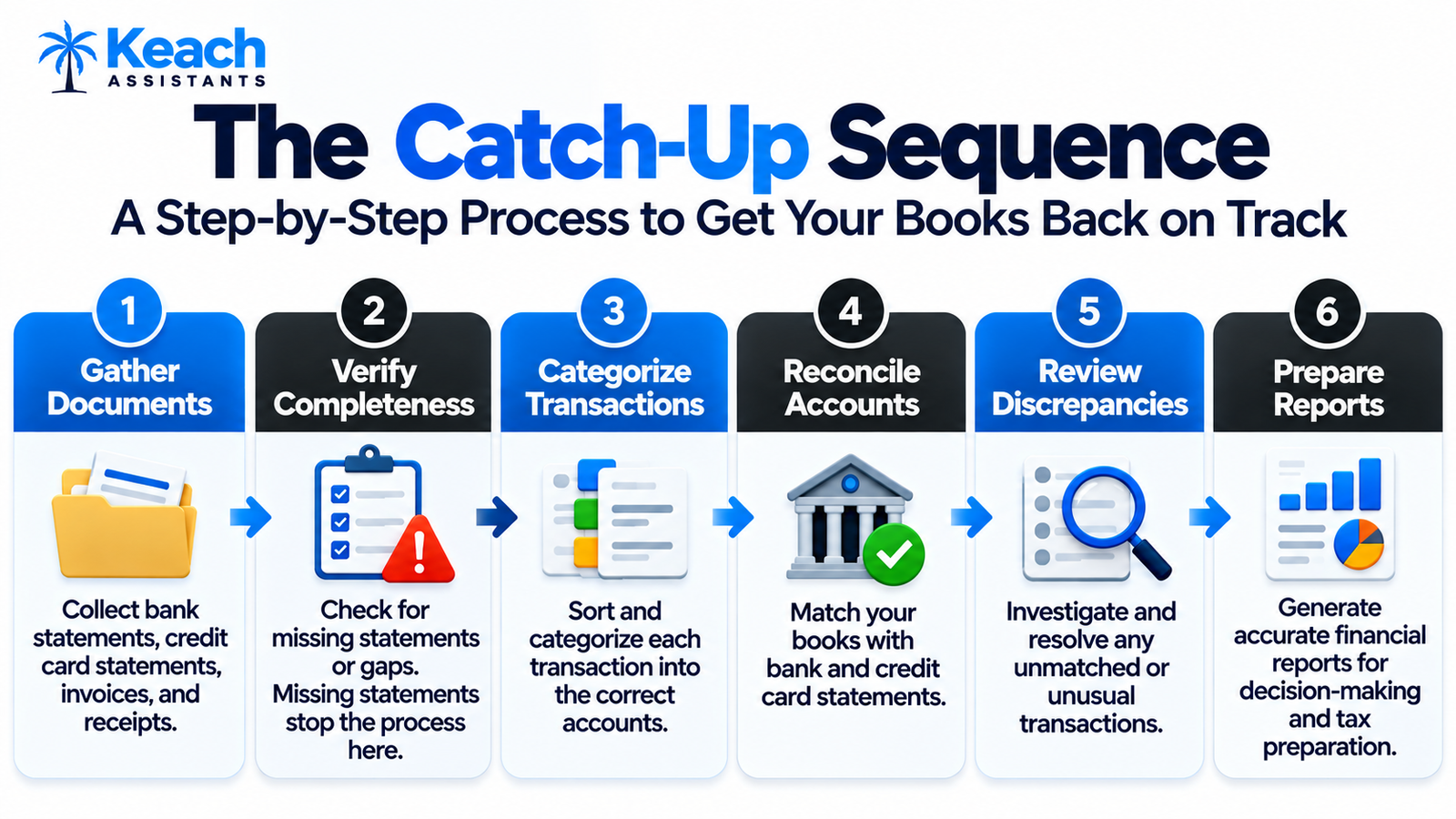
A remote bookkeeper working on a backlog typically moves through the same stages every time. Collect documents. Verify completeness. Categorize. Reconcile. Review. Report. Skipping ahead at any point creates problems that surface later, which is exactly what happened the first time the books fell behind.
How to Catch Up on Your Bookkeeping: A 6-Step Process
Why This Work Is Harder Than It Looks
The part most people underestimate is how many assumptions go into every entry. A charge from Amazon could be a business expense, a personal purchase, or a marketplace payout depending on context. A deposit from a client might be partial payment, a retainer, or a refund. A transfer between two accounts might look like income if you don’t know both accounts belong to the same business.
Multiply those judgment calls by hundreds of transactions across six months, and the complexity becomes clear. This is why trying to power through a backlog alone usually produces books that look finished but aren’t actually accurate, and the errors only surface later when the numbers stop making sense.
The other difficulty is time pressure. Backlogs usually get addressed because a deadline is approaching, which means there’s no room to be slow. Working with a remote bookkeeper who handles overdue cleanups regularly makes a bigger difference than most people expect, because pattern recognition from past cleanups speeds up every decision.
The Step-by-Step Process in Practice
A structured approach is what separates a clean recovery from a temporary patch. Here’s what the process typically looks like when a professional team handles it.
Document collection
Every bank statement, credit card statement, invoice, receipt, and platform payout report from the overdue period gets gathered in one place.
Account setup and review
QuickBooks or the existing accounting software gets organized with the correct accounts, currency settings, and chart of accounts for the business.
Transaction entry
Every transaction gets recorded, categorized, and matched against its source document.
Reconciliation
Each account gets reconciled month by month, and any discrepancies get flagged for review.
Error correction
Duplicate entries, miscategorized charges, and missing transactions get fixed before anything is finalized.
Reporting
Profit and loss statements, balance sheets, and any other reports the business needs get prepared for the period that was cleaned up.
The step-by-step process for overdue financial record cleanup services matters more than most business owners realize, because jumping around usually means repeating work. A backlog isn’t just a list of tasks. It’s a sequence that has to hold together.
Filing Taxes After the Books Are Clean
Once the records are current, the tax side becomes manageable. Late filings are common for businesses that fell behind on bookkeeping, and the IRS generally handles them as long as the records are accurate and the required forms get submitted properly.
What makes this stage easier is having a clean set of books to work from. A CPA or tax preparer can file from accurate records quickly. Filing from a mess means hours of reconstruction at accountant rates, which is why the fast turnaround cleanup bookkeeping services for overdue tax filing space exists in the first place. Getting the records in order is what makes the tax filing itself cheap and simple.
The reality is that most late filers are late because the records were late, not because they were trying to dodge anything. Once the books catch up, the tax work usually moves faster than expected.
What This Costs and What It Saves
The cost to hire a remote bookkeeper for historical cleanup and tax prep varies based on how many months are behind, how many accounts are involved, and how much of a mess everything is in. That’s the honest answer, even if it isn’t the answer people want.
What matters more than the cost itself is what waiting costs. Late filing penalties. Interest on unpaid taxes. Missed deductions that can’t be claimed after the fact. And the ongoing mental weight of knowing the books are behind, which is hard to put a number on but very real.
Most businesses that hire someone to handle the cleanup end up wishing they’d done it months earlier. Not because the cleanup was easy, but because the relief is immediate.
Conclusion: Catching Up Is One Project, Not a Lifestyle
Being behind on bookkeeping feels permanent, but it isn’t. It’s a specific problem with a specific solution, and once the records are current, keeping them current takes a fraction of the effort that catching up did.
Keach Virtual Assistant handles backlog cleanups with the same structured process used for ongoing remote bookkeeper work. From document collection to reconciliation to reporting, the team works through months of overdue records methodically so you’re not the one staring at a spreadsheet wondering where to begin. And once you’re caught up, staying current is a lot easier than getting here was.
Ready to Put the Backlog Behind You?
Keach Virtual Assistant covers the day-to-day, so year-end isn’t a scramble.
FAQs
How long will it take me to get caught up after being far behind in my bookkeeping for several months?
This varies depending on transaction amounts and how well the source documents have been kept. For example, a few months of a small business might take about two weeks, while a year or more of backlog will take longer. Clean records will get you there faster.
Will I be able to file my tax returns late if I am behind in my bookkeeping?
Yes, but usually the record-keeping needs to be done first. Filing your returns using incomplete or inaccurate books creates even more problems down the road. It is the act of getting your books up-to-date that makes filing late possible.
Will I have to go through all my receipts first?
Not necessarily. Most transactions can be reconstructed from bank and credit card statements, and any missing receipts rarely make a difference.
Does the bookkeeper do the taxes as well?
Not really. The bookkeeper prepares the information and organizes it. The CPA or tax preparer will file the tax return. Sometimes companies coordinate with the existing CPA to avoid losing anything in between.
Can I have mixed transactions in my books?
They will be sorted out during the process of organizing. Mixed accounts are among the most frequent problems that can arise with overdue books, and sorting them out is a part of the process.